

Find Aged Care Homes Near You That Fit Your Parent's Needs
To find aged care homes near me, start with your ZIP code and your parent's daily needs. Shortlist licensed assisted living or memory care homes that can provide the supervision and medication help they need. Then check California licensing and inspection records, call to confirm openings, and tour the homes that fit.
If you're searching in Whittier, pay close attention to overnight support and how residents spend their day. A tour lets you see whether the care feels both safe and welcoming before you make a decision.
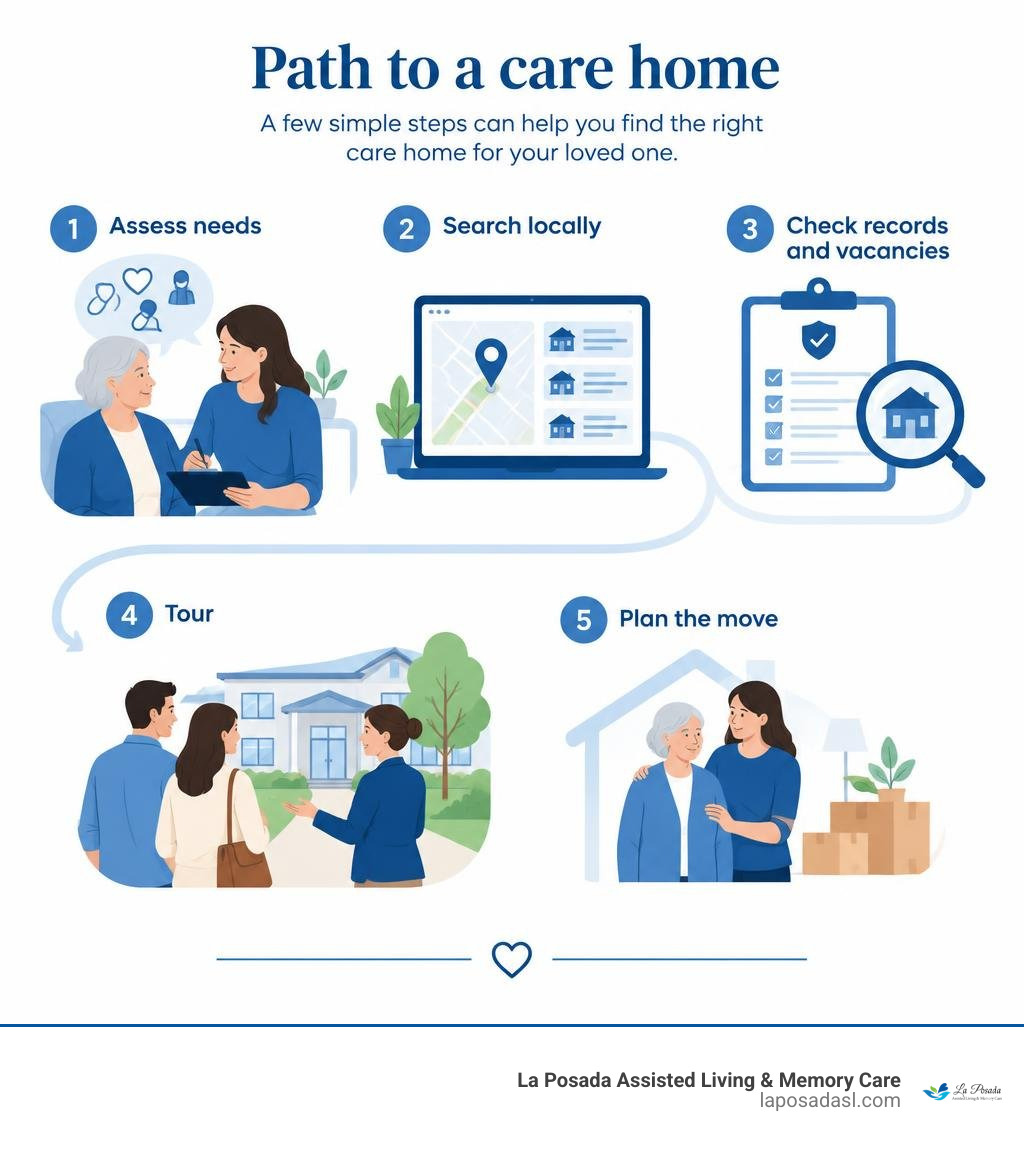
Shortlist the Right Type of Care
Before you type "care home" into a search bar, decide what kind of help your loved one needs day to day. The right setting depends on daily care needs, not just on which place has an open room. Many people do better in a smaller, more residential setting.
Here are the main settings to consider:
- Assisted living: Housing, meals, laundry, supervision, and help with bathing, dressing, grooming, and medications.
- Memory care: Assisted living designed for people with Alzheimer's or other dementia, with secure spaces and specially trained staff.
- Respite care: A short stay that gives family caregivers a break or covers a gap after a hospital visit.
In California, most assisted living is licensed as a Residential Care Facility for the Elderly (RCFE). The state's Assisted Living Facilities - Care Options page is a good place to learn how these homes are defined and overseen.
| Setting | Care level | Licensing | Typical services |
|---|---|---|---|
| Assisted living (RCFE) | Non-medical personal care and supervision | Licensed by California Department of Social Services | Meals, housekeeping, bathing and dressing help, medication assistance, activities |
| Memory care | Higher supervision for dementia | Licensed RCFE with dementia capability | Secure setting, structured routines, wandering prevention |
| Respite care | Short-term, matches the setting | Same as the host home | Temporary room, meals, care, activities |
What Aged Care Homes Near Me Offer in California
In California, "aged care" usually means an RCFE. These homes serve adults 60 and older who need help with daily activities but do not need ongoing medical care from facility staff. Some are small board and care homes of about six beds in a regular house. Others are much larger communities.
Typical RCFE services include:
- Help with bathing, dressing, grooming, and walking or transferring
- Meals, snacks, housekeeping, and laundry
- Medication assistance and supervision
- Transportation and activities
An RCFE may care for someone with dementia only if the home is equipped for it and has trained, sufficient staff. That is why memory care deserves its own questions.
Licensed homes are inspected by the state, so review current licensing and inspection records before scheduling a tour.

How to Find and Compare Aged Care Homes Near Me
A simple search process keeps this from feeling overwhelming:
- Search by ZIP code. Start with Whittier, then widen to nearby neighborhoods and cities. A home 15 minutes farther away may be worth it if it fits better, but close homes make frequent visits easier. Visits matter for emotional well-being.
- Use the state's licensing search. Verify each home through the California Department of Social Services, Community Care Licensing Division.
- Call each home directly. Online directories rarely show real-time openings, so ask about current vacancies, waitlists, room types (private or shared, studio or apartment), and what the monthly rate includes.
- Ask about care plans. Find out how needs are assessed, how often plans are reviewed, and what happens if needs increase.
- Confirm visit availability. Ask when tours are offered and whether you can come back at a different time of day.
Be careful with referral agencies. Some are paid by the homes they recommend, so ask how they are compensated before you rely on their shortlist.

How to Compare Aged Care Homes Near Me Before Touring
Paper research saves you from touring the wrong places. Check these items for every home on your list:
- California licensing: Confirm the license is current and covers the level of care you need, including dementia care.
- Inspection reports: Read recent state inspections and note any cited problems.
- Complaint history: Look for patterns, not one-off issues. Ask how the home corrected anything cited.
- Staffing information: Ask for staff-to-resident ratios by shift. Assisted living ratings and staffing rules vary, so do not assume every home is held to the same standard.
- Resident experience: Read reviews, but also ask families and residents directly.
Ownership is not a quality guarantee. Research from Australia found that the ten largest chains average only 3.4 to 3.9 stars out of five, and the same chain can run both 2-star and 5-star homes. Judge the individual home, not the logo.
A caution: Australian aged care star ratings, such as those in My Aged Care assessment and provider-selection steps, are not California ratings and do not apply to Whittier homes. They are useful mainly as an example of what good public data looks like. Their approach is worth borrowing: look at staffing, compliance, and resident experience separately instead of trusting one headline number. In that system, 59% of homes missed at least one care-minute target in one recent quarter, and a third reported spending under $10 per resident per day on food. Numbers like these show why you should ask for specifics.
Tour Checklist: Quality, Safety, and Resident Fit
Trust what you see over what you are told. Bring a notebook, and if possible visit more than once, including once unannounced.
While you walk through, look at:
- Staffing levels: Are caregivers visible and unhurried? Do they greet residents by name?
- Caregiver turnover: Ask how long the manager and caregivers have been there. Frequent turnover can disrupt consistent care.
- Overnight coverage: Ask how many awake staff are on at night and who responds to a call.
- Care-plan reviews: Ask how often plans are updated and whether families join.
- Medication support: Ask who manages medications and how errors are prevented and reported.
- Meals and hydration: Check menus, snack availability, and whether water is within reach. Malnutrition is a real concern: a study cited by Australia's Royal Commission found 68% of residents malnourished or at risk, and a 2024 study still found about 40%.
- Activities: Look for a varied calendar, not just a TV in the common room.
- Family updates: Ask how and when families are told about falls, illness, or changes.
- Cleanliness: Notice odors, clutter, and the condition of rooms and bathrooms.
- Emergency response: Ask about call systems, staff training, and evacuation plans.
- Resident rights: Ask for a copy of residents' rights and how complaints are handled.
The Long-Term Care Ombudsman is a free advocate for residents. Families can call the 24-hour hotline at 1-800-231-4024 with concerns or questions about rights.
What to Ask Staff and Residents During a Tour
Good homes welcome tough questions. Try these, and ask to see proof where you can:
| Question to ask | What to verify |
|---|---|
| How many caregivers are on each shift, including nights? | Posted schedules, license capacity |
| What training do caregivers have? | Training records, dementia training hours |
| How fast do staff answer call buttons? | Ask residents; watch during the tour |
| Is a nurse available, and when? | Written description of nurse access |
| How are incidents reported to families? | Sample incident notification process |
| How are complaints resolved? | Written complaint policy |
| What added-care fees might apply? | Written fee schedule and assessment criteria |
| Would you recommend living here? (ask a resident) | Consistent answers from several residents |
Also ask about:
- Food: Who plans the menu? Are special diets honored? Can you stay for lunch unannounced? A mealtime visit shows food quality and the dining atmosphere.
- Memory care: What dementia training does staff receive? How do they prevent wandering without making residents feel locked in?
- Culture and faith: Are language, dietary, and religious preferences respected and supported?
Costs, Financial Help, and the Admissions Process
Costs vary widely, so ask each home for a written fee schedule. Several things shape the monthly bill:
- Room type: Private, shared, studio, or apartment
- Care-level charges: Extra fees often apply when assessed needs rise
- Medication management: Often priced separately
- Move-in fees: One-time community or assessment fees
- Respite rates: Often a daily rate for short stays
Ask exactly what is included and how often rates change.
Ways to pay include:
- Private pay: Savings, retirement income, or home sale proceeds
- Long-term care insurance: Check the policy for benefit triggers and waiting periods
- Medi-Cal: Eligibility depends on income, assets, and care needs, and only some licensed providers participate, so confirm with each home
- Medicare: It does not generally pay for long-term assisted living.
Verify Medicaid or Medi-Cal participation before assuming help is available at a specific home.
The admissions process usually looks like this:
- Needs assessment by the home, often with input from your loved one's doctor
- Physician records, including a recent medical report and medication list
- Application and agreements, which you should read carefully
- Deposits and fees, and ask what is refundable
- Waitlist or move-in date
- Discharge planning if your loved one is coming from a hospital or rehab stay
Frequently Asked Questions about Aged Care Homes Near Me
How can I check whether a California care home is licensed and safe?
Search the California Department of Social Services, Community Care Licensing Division, for the home's license and recent inspection results. Look at complaints and any corrective actions the home was required to make. Then call the Long-Term Care Ombudsman with questions. They visit homes, advocate for residents, and investigate abuse or neglect allegations.
Can Medicare or Medi-Cal pay for assisted living or memory care?
Medicare generally does not cover long-term assisted living or memory care. Medi-Cal may help eligible people, but you must meet financial and care-need rules, and the home must be a licensed provider that participates. Always confirm at the specific home.
What should I do if there is no immediate vacancy?
- Ask to join the waitlist and how often to check in
- Look at nearby settings in neighboring communities
- Consider respite care as a bridge
- Arrange interim in-home support
- Reassess regularly, since needs and openings change
Conclusion
The best choice comes from comparing verified records with what you actually observe on tours. Licenses, inspections, and complaint histories tell you the facts. Your eyes and ears tell you whether people are treated with warmth. Choose based on current needs, and plan for changing ones.
At La Posada Assisted Living & Memory Care, we are a family-owned community in Whittier. We offer personalized, 24-hour care and holistic programs for body, mind, and spirit, with individualized service plans and a focus on social connection. If you would like to see us in person, learn more about assisted living, memory care, and respite care in Whittier and schedule a visit. We would be glad to show you around, answer every question, and help you decide with confidence.