

What Does a Live-In Home Health Aide Cost in 2026?
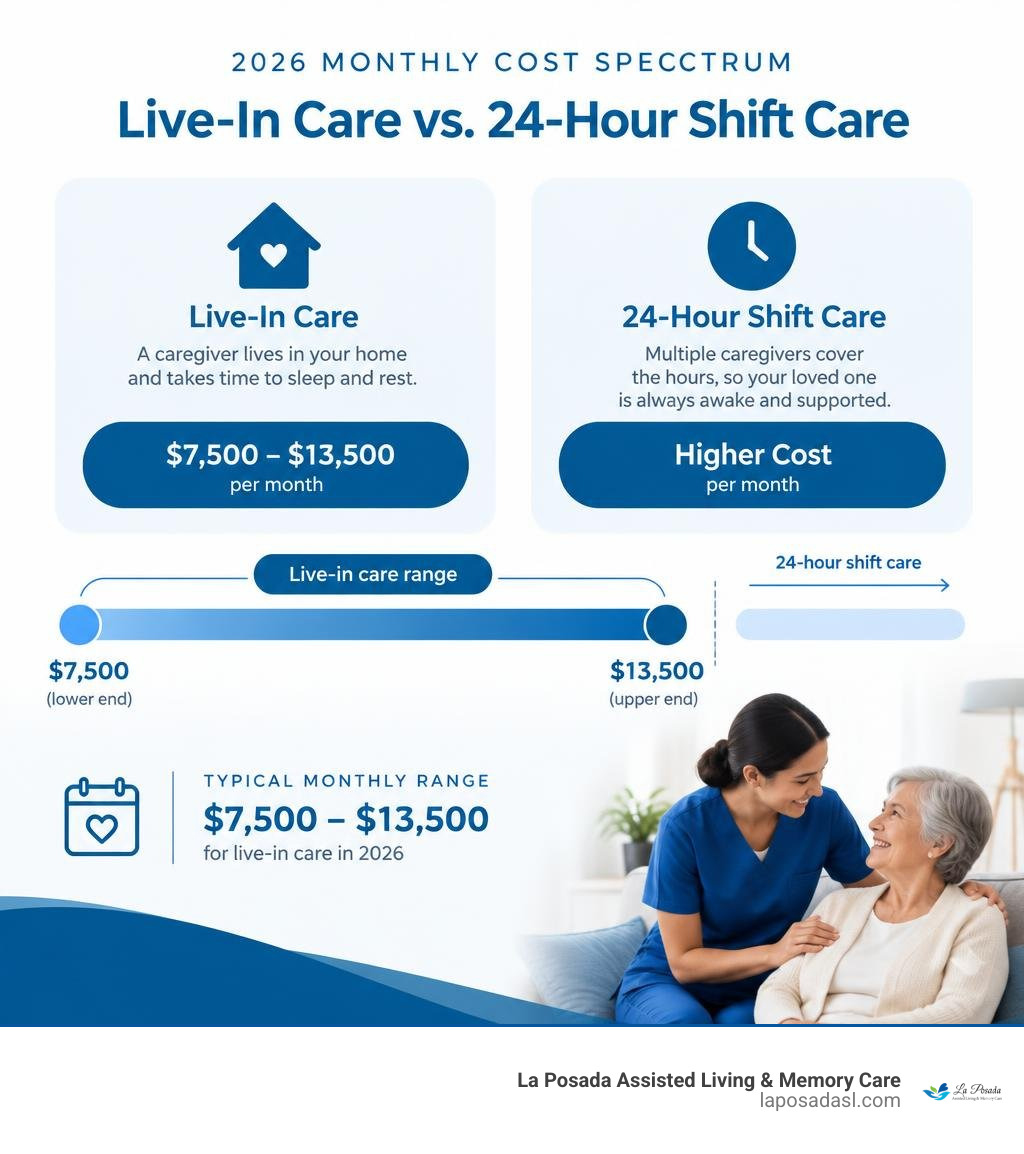
Budget about $7,500 to $13,500 per month for live-in care in 2026. Many families will see quotes closer to $9,000 to $13,500, depending on where they live and how much help their parent needs.
A live-in aide stays in the home but needs time to sleep and rest. If your parent needs someone awake and available all night, ask for a quote for 24-hour shift care instead. That costs more because multiple caregivers must cover the hours. Compare both options against your parent's care needs before setting a monthly budget.
Understanding the Average Cost of Live In Home Health Aide Care in 2026
When evaluating long-term care options, determining the average cost of live in home health aide support is often the first major hurdle for families. Nationally, live-in home care costs between $250 and $450 per day, translating to an average monthly expense of $7,500 to $13,500. For households requiring consistent support throughout the year, annual budgets frequently span between $90,000 and $160,000.
These figures reflect ongoing economic shifts. The national median hourly rate for in-home aides reached approximately $35 per hour in 2026, driven by an annual growth rate of roughly 4.2% over the last decade that continuously outpaces general inflation. For families needing a standard 40-hour workweek of daytime assistance, the median cost sits around $72,800 annually. When round-the-clock presence is required, daily rates apply, but rising wage pressures continue to push baseline figures upward.
A major driver behind these pricing trends is the severe workforce squeeze. As highlighted by caregiver industry trends on labor shortages, recruiting and retaining qualified professionals has become increasingly difficult. Projections indicate a national deficit of 3.8 million direct care workers by 2030. Combined with mandatory state minimum wage increases across 18 states in recent years, agencies must adjust their billing rates to offer competitive pay, maintain required insurance, and comply with state and federal labor mandates.
Daily and Monthly Average Cost of Live In Home Health Aide Services
Live-in care operates on a daily rate model rather than an hourly tally, but it comes with strict legal and practical requirements. Under federal and state labor laws, a live-in home health aide must be provided private sleeping quarters and must receive at least eight hours of sleep time per night, with a minimum of five continuous hours of uninterrupted rest. They are also entitled to regular meal breaks throughout the day.
If an elder wakes up frequently at night for toileting, medication, or due to dementia-related wandering, the caregiver is not getting their required rest. Under labor regulations, if night interruptions routinely break the sleep window, the family must pay standard hourly wages for those hours or transition entirely to shift care.
The table below illustrates how different home-based care structures compare financially in 2026:
| Care Structure | Description | Daily Rate Range | Monthly Cost (30 Days) | Annual Budget Projection |
|---|---|---|---|---|
| Hourly Visit Care (40 hrs/wk) | Daytime assistance, 8 hrs/day, Mon–Fri | $240 – $320 (at $30–$40/hr) | $5,200 – $6,900 | $62,400 – $83,200 |
| Live-In Aide (Flat-Day Rate) | 1 aide lives on-site; requires 8 hrs sleep + meals | $250 – $450 / day | $7,500 – $13,500 | $90,000 – $162,000 |
| 24-Hour Shift Care | 2–3 caregivers rotating in 8- or 12-hr awake shifts | $720 – $1,080 / day | $21,600 – $32,400 | $259,200 – $388,800 |
Regional Variations Influencing the Average Cost of Live In Home Health Aide Care
Where your family lives dramatically influences final care invoices. In high-cost regions such as the West Coast and the Northeast, monthly fees for live-in aides routinely span from $12,000 to $18,000. Conversely, families residing in the Deep South or rural Midwestern communities often pay between $6,500 and $9,000 per month for equivalent hours of service.

A closer look at state-level rates reveals clear tiers:
- Tier 1: Premium Markets ($38–$45/hour equivalent / $12,000–$18,000 monthly): States like California, Washington, New York, and Massachusetts feature higher baseline minimum wages, comprehensive worker benefit requirements, and high costs of living.
- Tier 2: Mid-High Markets ($32–$38/hour equivalent / $9,500–$12,500 monthly): States in the Upper Midwest, Mountain West, and Mid-Atlantic—such as Colorado, Minnesota, and Pennsylvania—fall into this bracket.
- Tier 3: Midrange Markets ($28–$32/hour equivalent / $7,500–$10,500 monthly): States such as Texas, Florida, and North Carolina offer moderate pricing. In Florida, for instance, daily rates range from $200 to $350 ($6,000 to $10,500 per month), though urban areas in South Florida average 10% to 15% higher.
- Tier 4: Lower-Cost Markets ($24–$28/hour equivalent / $6,500–$9,000 monthly): Rural areas across Louisiana, Mississippi, and Alabama demonstrate the lowest average costs nationwide.
For an extensive geographic breakdown across all fifty states, consult the 2026 state-by-state home care pricing guide.
Key Factors and Hidden Expenses That Drive Home Care Rates
Base quotes rarely represent the total amount a family pays each month. The complexity of care required is the primary driver of cost. Providing basic companion care—such as meal preparation, light housekeeping, and medication reminders—sits at the lowest end of the price spectrum. However, when an older adult requires hands-on assistance with Activities of Daily Living (ADLs)—such as bathing, dressing, toileting, mechanical lift transfers, or specialized memory support for Alzheimer's disease—daily rates rise.

Beyond core tasks, secondary expenses accumulate quickly:
- Caregiver Food and Groceries: Families are responsible for providing adequate meals and groceries for a live-in aide, which adds $300 to $600 per month to household expenses.
- Room Accommodations: Preparing and maintaining a furnished, private bedroom with appropriate bedding, heating, and cooling requires an upfront and ongoing investment.
- Mileage and Transportation: If the aide drives your parent to medical visits or runs errands using their personal vehicle, standard IRS mileage reimbursement rates apply.
- Medical Supplies and Sanitation: Gloves, incontinence supplies, barrier creams, and cleaning products are paid for out of pocket by the family and can add $100 to $300 monthly.
Agency vs. Private Hire Pricing Realities
Families facing high monthly quotes often consider hiring an independent caregiver directly to save money. Independent caregivers typically charge $20 to $28 per hour, while home care agencies charge $28 to $40 or more per hour. While direct hiring looks economical on paper, it shifts substantial legal, financial, and administrative responsibilities to the family.

When hiring privately, the homeowner becomes a household employer under IRS guidelines. This requires:
- Payroll and Tax Compliance: Withholding and submitting Social Security, Medicare (FICA), and federal and state unemployment taxes (FUTA/SUTA), which adds 8% to 15% over the base pay rate.
- Workers' Compensation and Liability Insurance: Standard homeowner policies rarely cover work-related injuries sustained by domestic employees. A specialized workers' compensation policy is essential to avoid severe financial liability if an aide is injured during a transfer.
- Background Screening: The family must personally pay for and conduct comprehensive criminal background checks, driving record verifications, and professional reference calls.
- Absence and Respite Coverage: If a private aide becomes ill, takes a vacation, or encounters an emergency, the family must immediately step in or hire emergency backup staff at premium rates.
Licensed agencies package these obligations into their billable rate. They handle recruiting, vetting, payroll processing, general liability coverage, bonding, workers' compensation, and backup staffing when the primary aide is off duty.
Caregiver Skill Levels and Unplanned Add-on Fees
The credentials of your caregiver directly influence billing rates. A companion or homemaker without clinical licensing commands the lowest hourly rate ($22–$30). A Certified Nursing Assistant (CNA) or certified Home Health Aide (HHA) trained in dynamic transfers, vital sign monitoring, and catheter care commands $28–$38 per hour. If physician-ordered Skilled Nursing visits are required for complex wound management or IV therapy, licensed practical nurses (LPNs) or registered nurses (RNs) bill at $85 to $120 per hour.
Unplanned fees can also impact monthly budgets:
- Holiday Premiums: Most agency agreements require time-and-a-half or double-time pay on recognized state and federal holidays (e.g., Thanksgiving, Christmas, New Year's Day).
- Emergency Short-Notice Surcharges: Requesting care on short notice following a sudden hospital discharge often carries initial assessment fees of $100 to $300 alongside elevated introductory hourly rates.
- Split-Shift Differential: If care hours must be fragmented across morning and evening routines rather than a continuous block, agencies charge higher minimum hourly rates per visit.
Financial Assistance Programs and Cost-Saving Strategies
Because continuous in-home support involves substantial long-term investments, families should explore all public and private financing avenues. Understanding the broader context of long-term care expenditures over past decades—as documented in historical long-term care cost metrics—shows that planning early provides the widest array of payment options.
Leveraging Medicaid Waivers, Veterans Benefits, and Long-Term Care Insurance
A common misconception is that standard health insurance or Medicare pays for ongoing, custodial home care. Medicare does not pay for non-medical live-in care. Medicare Part A and B strictly cover intermittent, short-term skilled care (such as physical therapy or wound dressing) for homebound individuals under an active physician's plan of care, capped at part-time hours.
Families must look to alternative financing channels:
- Medicaid Home and Community-Based Services (HCBS) Waivers: Every state manages Medicaid waiver programs designed to help income-qualified seniors receive care at home rather than entering a skilled nursing facility. Programs such as California's In-Home Supportive Services (IHSS), New York's CDPAP, or Florida's Long-Term Care Managed Care program provide financial support for care hours, though many maintain enrollment waitlists.
- VA Aid and Attendance Benefit: Qualified wartime veterans and their surviving spouses who require help with daily living activities can secure monthly, tax-free pension enhancements. Eligible couples can receive upwards of $2,700 monthly, while single veterans can access more than $2,200 per month to offset home care invoices.
- Long-Term Care Insurance (LTCI): Traditional policies often reimburse daily or monthly home care costs up to a specified maximum. Families must review policy terms carefully regarding the elimination period (typically 30 to 90 days of self-funded care before benefits trigger) and check whether the policy mandates hiring through a licensed agency rather than an independent caregiver.
Practical Methods to Lower Monthly In-Home Care Expenses
When paying privately, structured scheduling adjustments can reduce out-of-pocket costs without sacrificing safety:
- Implement a Hybrid Care Plan: Instead of retaining a live-in aide seven days a week, utilize a full-time aide for four or five days, covering weekends with family support or local adult day health programs. This strategy can reduce monthly agency invoices by 20% to 30%.
- Consolidate Care Tasks: Schedule hourly aides during high-need windows (such as morning dressing and bathing, followed by evening meal preparation and bedtime routines) rather than keeping an aide on the clock for unengaged afternoon downtime.
- Share Care Schedules Among Family: Organize a rotating family calendar to provide overnight supervision, allowing you to use daytime visit aides at an hourly rate while avoiding full live-in fees.
- Negotiate Long-Term Retainers: Agencies are sometimes open to reducing flat-day rates by 5% to 10% in exchange for guaranteed, long-term multi-month service agreements.
Comparing Live-In Care to Residential Senior Living Options
When monthly home health aide invoices approach $9,000 to $13,500, comparing that investment against community-based residential environments becomes an important step. While home care offers one-on-one attention in familiar surroundings, it can inadvertently lead to social isolation and leaves homeowners managing maintenance, meal preparation, and separate utility bills.
Residential communities combine 24-hour supportive care, personalized wellness programming, chef-prepared dining, social activities, and housekeeping into a predictable monthly rate. Exploring dedicated assisted living environments allows families to secure round-the-clock safety and community engagement, frequently at a more predictable cost than full-time home health aides.
The table below contrasts full-time live-in home care with residential community models:
| Feature | Live-In Home Health Aide | Assisted Living & Memory Care Community |
|---|---|---|
| Typical Monthly Cost | $7,500 – $13,500+ (plus food/housing) | $4,500 – $8,500 (all-inclusive base) |
| Coverage Continuity | Dependent on 1 individual (sleep rules apply) | Professional team on-site 24/7/365 |
| Overnight Care | Must sleep 8 hrs; requires relief if woken | Dedicated awake night staff available immediately |
| Social Engagement | Limited to aide and visiting family | Daily social events, group outings, peer interactions |
| Household Maintenance | Family manages repairs, bills, taxes, groceries | Complete maintenance, housekeeping, linen service included |
| Home Modifications | Out-of-pocket expenses (ramps, grab bars, lifts) | Fully ADA-accessible, purpose-built living environments |
Frequently Asked Questions About Live-In Home Care
How Does Live-In Care Differ From 24-Hour Shift Care?
The primary differences lie in caregiver rest requirements, staffing levels, and total price.
- Live-in care involves a single caregiver who resides in the home for consecutive days. They must receive an eight-hour sleep window (with at least five uninterrupted hours) and private sleeping accommodations. Because they sleep on-site, the daily rate is lower ($250–$450/day).
- 24-hour shift care utilizes two or three rotating caregivers working 8- to 12-hour shifts. Caregivers remain awake, alert, and on duty throughout their entire shift. Because this model involves multiple employees working around the clock at standard or overtime hourly rates, monthly costs run from $21,000 to $32,000+, more than double the cost of live-in care.
Does Medicare Cover Any Portion of Live-In Home Health Aide Services?
No. Original Medicare (Parts A and B) and Medicare Advantage plans do not cover custodial, non-medical live-in care. Medicare strictly funds intermittent, part-time skilled services ordered by a physician—such as physical therapy, occupational therapy, speech-language pathology, or wound care—for patients certified as homebound. While an HHA may assist with bathing during an active skilled therapy episode, support is limited to a few hours per week and does not cover daily residential living assistance.
What Are the Employer Tax Obligations When Hiring an Independent Live-In Aide?
If you pay an independent caregiver over the annual IRS household employee threshold, you are legally considered a household employer. You must withhold and match FICA taxes (7.65% employee, 7.65% employer share), pay federal (FUTA) and state (SUTA) unemployment taxes, secure workers' compensation insurance to protect against on-the-job injuries, and provide annual W-2 filings. Failing to manage household payroll taxes correctly can trigger substantial back-tax penalties and legal liability.
Conclusion
Determining whether to hire a live-in home health aide requires balancing family budgets, physical safety requirements, and your loved one's emotional wellbeing. At an average cost of $7,500 to $13,500 per month in 2026, round-the-clock in-home care is a major financial commitment that requires careful long-term planning.
If your parent needs consistent oversight, companionship, and help with daily routines, it is worth comparing all your options. At La Posada Assisted Living & Memory Care in Whittier, CA, our family-owned community delivers personalized, 24-hour support within a warm, socially connected environment. Reach out to our team today to discuss your family's needs, review financial options, and discover how our holistic approach to elder care can give your family lasting peace of mind.