

Understanding Independent Living for Disabled Adults: Philosophy and Rights
Independent living for disabled adults means having the same right as anyone else to choose where and with whom to live, and to direct one's own daily life in the community. It is made possible through individualized supports and services—such as accessible housing, personal assistance, transportation, and skills training—that enable self-determination rather than segregation. This approach is rooted in a civil rights movement that began in the 1960s, led by disabled advocates who demanded the right to step out of segregated institutions and into the heart of their neighborhoods. Today, this philosophy shifts how society views disability. Under the social model of disability, the barrier is not a person's physical or cognitive diagnosis; rather, the true barriers are inaccessible buildings, discriminatory policies, and rigid systems that isolate people.
International human rights standards, notably the UN Committee on the Rights of Persons with Disabilities' General Comment No. 5, define independent living as a holistic civil right. It ensures that individuals with disabilities have access to all necessary means—such as accessible transportation, personal assistance, and community housing—to exercise full self-determination. In California, state frameworks like the Rights Under the Lanterman Act reinforce this principle by legally guaranteeing that individuals with developmental disabilities receive the services and supports needed to live in the least restrictive environment possible.
Self-Determination Versus Total Self-Sufficiency
A common misconception is that living independently requires complete self-sufficiency. In reality, nobody in modern society is entirely self-sufficient—we all rely on grocery store clerks, mechanics, doctors, and public utilities.
For an adult with a disability, independence is about self-determination: retaining choice and control over everyday decisions. It means deciding what time to wake up, what meals to eat, who enters your private home, and how your day is structured. Even if someone relies on a support worker for mobility, meal preparation, or financial budgeting, they remain independent as long as they direct their own life. Independent living honors everyday dignity by prioritizing personal interdependence over forced isolation.
Legal Protections Under UN CRPD Article 19
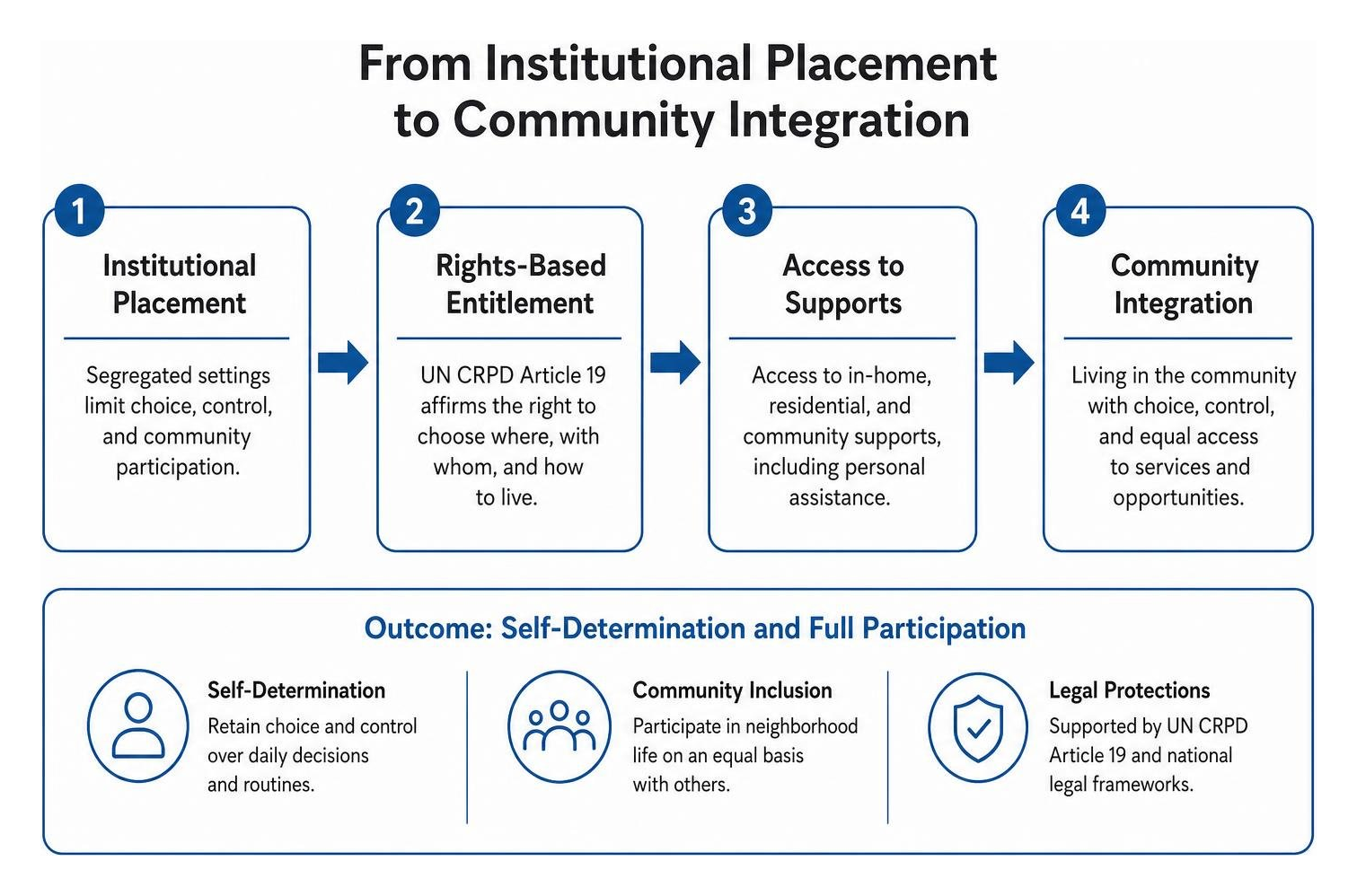
Article 19 of the United Nations Convention on the Rights of Persons with Disabilities (CRPD) recognizes the equal right of all persons with disabilities to live in the community, with choices equal to others. It explicitly mandates that:
- Persons with disabilities have the opportunity to choose their place of residence and where and with whom they live on an equal basis with others.
- Individuals have access to a range of in-home, residential, and community support services, including personal assistance necessary to prevent isolation.
- Community services and facilities for the general public are available on an equal basis and are responsive to their needs.
Despite global commitments, systemic hurdles remain widespread:
- Over one million persons with disabilities across the European Union still reside in segregated institutions, deprived of basic autonomy.
- Globally, children with disabilities are 17 times more likely to be placed into institutional care than children without disabilities.
- In research reviewing residential experiences, fewer than half of nearly 7,000 surveyed adults with intellectual disabilities reported having the freedom to choose where they lived and who shared their living space.
Transitioning toward self-directed adulthood requires navigating these frameworks with clear legal guidance, as highlighted in comprehensive resources like the Adult Transition and Legal Rights Handbook.
Comparing Housing and Support Service Models Along the Independence Continuum

Finding the right housing arrangement involves identifying where an individual's goals and needs fit along the residential continuum. Community-based support models separate housing from service provision, ensuring that a change in support needs does not force someone to lose their home.
| Housing & Support Model | Typical Support Level | Decision-Making Autonomy | Best Suited For |
|---|---|---|---|
| Independent Living (with CIL / ILS) | Intermittent, skills-focused visits (a few hours per week) | Full individual control over lease, daily schedule, and services | Individuals seeking skill development to live alone or with self-chosen roommates |
| Supported Living Services (SLS) | Flexible, customized support ranging from daily check-ins to 24/7 in-home assistance | High autonomy; person holds their own lease with customized personal schedules | Adults wanting to live in private homes who require ongoing functional assistance |
| Community Living Settings | Shared home environments with scheduled or shared direct-care staff | Shared house rules with personal room autonomy and collaborative routines | Individuals who thrive with built-in social structures and shared support resources |
| Residential / Assisted Living Care | 24-hour continuous care, integrated meals, and comprehensive personal assistance | Structured community schedule with personalized care plans | Adults requiring ongoing personal care, health monitoring, and social engagement |
Core Support Models of Independent Living for Disabled Adults
Centers for Independent Living (CILs) are consumer-controlled, community-based non-profit organizations that form the backbone of the independent living infrastructure. Unlike traditional clinical agencies, CILs are governed and staffed primarily by people with disabilities.
These centers generally deliver five core services at no charge:
- Information and Referral: Connecting individuals with community housing, legal aid, and assistive tools.
- Independent Living Skills Training: Structured instruction covering household budgeting, accessible transit navigation, meal planning, and self-care.
- Peer Counseling: Guidance and mentorship from peers with lived disability experience.
- Individual and Systems Advocacy: Protecting disability rights and addressing local accessibility barriers.
- Transition Services: Assisting individuals moving from institutional settings back into their neighborhoods, or guiding young adults leaving school.
In many states, such as through Texas Independent Living Services, agencies pair these free core services with purchased services. Purchased supports provide financial assistance on a sliding scale for home modifications (like wheelchair ramps and stairlifts), vehicle adaptations, and specialized assistive technology evaluations.
Supported Living Services (SLS) Versus Independent Living Skills (ILS)
Understanding the distinction between skill acquisition and ongoing direct support is critical when organizing state-funded disability programs:
- Independent Living Skills (ILS): ILS is a training-focused, time-limited program designed to teach functional daily skills. A coordinator works alongside the individual to build competence in areas like cooking, cleaning, public transportation, and personal finances. The goal is progressive skill building so the person can manage tasks on their own over time. State-funded programs like the California DDS Independent Living Program help adults with developmental disabilities master these essential routines.
- Supported Living Services (SLS): SLS provides direct, ongoing personal support rather than just training. It is designed for adults who need continued assistance to live in a home they own or lease. SLS supports people indefinitely, regardless of the severity of their disability, offering everything from a few hours of weekly personal care to 24-hour hands-on support.
Community Living Settings and Tailored Personal Supports
For individuals moving beyond the family home, various community models combine private space with individualized assistance. In supported living departments such as the SEEC Supported Living Overview, participants are guided through person-centered transition programs to secure apartments or townhouses of their choice.
These programs offer flexible staffing, roommate matching based on shared interests, and remote support technologies. Remote monitoring uses smart sensors and secure communication systems, allowing individuals to contact support staff on demand during the night without needing an aide stationed inside their home at all times.
Overcoming Structural, Familial, and Cultural Barriers to Autonomy
The transition from the family home to community independence is rarely simple. Scoping reviews indicate that out of 27 studies examining young adults with intellectual disabilities, 23 found that the vast majority continue living with their parents well into adulthood, often remaining in the parental home far longer than their non-disabled peers.
This delay stems from real-world barriers:
- Severe Housing Shortages: A lack of affordable, physically accessible rental units.
- Systemic Information Gaps: Families often struggle to navigate disjointed public benefit systems and long Medicaid waiver waitlists.
- Familial Anxiety and Protective Instincts: Parents frequently carry the emotional burden of worry, fearing their loved one will face loneliness, financial vulnerability, or inadequate care without them.
- Cultural and Interdependence Expectations: In many cultures, family caregiving is viewed as a lifelong familial obligation rather than an arrangement that should end in young adulthood.
Overcoming these barriers requires gradual transition planning, early skill acquisition, and building circles of natural support—such as friends, extended family, and local peer advocates—alongside paid professionals.
Supported Decision-Making Versus Guardianship
Historically, when a young adult with an intellectual disability turned 18, families were encouraged to seek full legal guardianship or conservatorship. However, plenary guardianship strips an individual of their legal capacity, removing their right to make basic decisions about where to live, how to spend money, or who to associate with.
Supported Decision-Making (SDM) offers a modern alternative aligned with CRPD Article 12. SDM recognizes that everyone needs advice when making major life choices. Under an SDM agreement, the disabled adult retains their full legal rights and chooses a trusted circle of supporters—such as parents, siblings, or mentors—to help them:
- Gather and understand relevant information in accessible formats (like plain-language or visual guides).
- Weigh the pros and cons of housing, medical, and financial options.
- Communicate their personal choices to service providers, banks, and landlords.
Legal tools like Powers of Attorney and healthcare directives can formalize this support without taking away an individual's civil autonomy.
Balancing Personal Safety with the Dignity of Risk
A central challenge for families and care teams is balancing safety with autonomy. Complete risk elimination is impossible; attempting to remove all risk results in overprotection, which restricts personal development.
The "dignity of risk" means recognizing that self-esteem and growth come from making choices, trying new things, making mistakes, and learning from the outcomes. Support teams can protect individuals by implementing proactive safety plans rather than restrictive rules:
- Developing clear crisis and emergency response protocols for the home.
- Practicing community safety and stranger awareness skills in real-world settings.
- Using assistive technology (like automated stove shut-offs or medication dispensers) to solve safety concerns without removing autonomy.
Creating an Actionable Plan for Community Integration

Moving into community-based housing requires a structured, step-by-step approach that aligns personal goals with available funding sources.
Actionable Steps to Secure Independent Living for Disabled Adults
Developing a sustainable housing strategy is easier when broken down into clear stages, as outlined in the Individualized Housing Options Guide:
- Clarify Personal Preferences: Define your ideal community setting, preferred neighborhood, proximity to public transit, and whether you prefer living alone or with roommates.
- Conduct an Ecological Needs Assessment: Identify specific daily tasks where support is needed, such as cooking, medication routines, bill payments, and mobility assistance.
- Engage Case Management: Contact your local service agency, regional center, or CIL to incorporate housing goals into your formal plan (such as an Individual Program Plan).
- Secure Housing Navigation and Leasing Supports: For individuals with limited credit history, explore transitional lease options—where an agency holds the lease temporarily before transferring it to the tenant—and apply for local housing vouchers.
- Establish Circles of Support: Coordinate schedules with personal care assistants, natural community supports, and emergency contacts before move-in day.
Role of Personal Assistants, Peer Networks, and Assistive Technology
Modern independent living relies on a blend of human support and accessible technology:
- Personal Assistants (PAs): PAs assist with hands-on tasks directed by the individual, helping with personal hygiene, grocery shopping, cooking, and community outings.
- Peer Support Networks: Connecting with local self-advocacy groups allows individuals to exchange practical tips, build friendships, and solve everyday challenges with peers who share similar experiences.
- Assistive Smart-Home Technology: Voice-activated lighting, visual doorbells, smartphone-based daily planners, and remote environmental controls help individuals manage their households with less reliance on in-person staff.
Navigating Funding Streams and Public Benefits
Securing stable independent housing requires combining multiple financial resources:
- Supplemental Security Income (SSI) & SSDI: Provides basic monthly income to cover living expenses like rent, food, and utilities. A practical rule of thumb is keeping housing costs at or below 33% of monthly income whenever possible.
- Medicaid Home and Community-Based Services (HCBS) Waivers: State-administered waivers fund essential in-home personal supports, respite care, assistive devices, and case management.
- Housing Choice Vouchers (Section 8): Federal rental assistance programs that cap tenant rent contributions at roughly 30% of their adjusted monthly income.
- ABLE Accounts and Special Needs Trusts: Tax-advantaged financial tools that allow individuals with disabilities to save money for housing, personal care, and assistive technology without jeopardizing their eligibility for means-tested public benefits like Medicaid and SSI.
Frequently Asked Questions About Independent Living
Can adults with intellectual disabilities live on their own?
Yes. With person-centered planning, accessible information, and the right combination of personal assistance and skill training, adults with intellectual disabilities can live in private apartments and homes across their communities. The level of support can be customized, ranging from a few hours of weekly budgeting help to comprehensive daily assistance.
Who qualifies for supported living services and how is it funded?
Eligibility generally requires a documented developmental, intellectual, or significant physical disability, confirmed through a state assessment. Services are primarily funded through state developmental service agencies, Medicaid Home and Community-Based Services (HCBS) waivers, and local housing support programs. Living expenses such as rent and groceries are typically covered by the individual using employment income or Supplemental Security Income (SSI).
What is the main difference between independent living and institutional care?
The core difference lies in choice, control, and community presence. In institutional care, daily schedules, meals, staffing, and room assignments are determined by the facility's administration, isolating residents from the broader public. In independent living, the individual holds their own lease, manages their daily routine, chooses who enters their home, and participates as an active member of their local community.
Conclusion
Independent living is more than just a housing arrangement—it is a commitment to dignity, civil rights, and community inclusion. By combining person-centered planning, supported decision-making, and adaptive support services, adults with disabilities can successfully direct their own lives and thrive in their neighborhoods.
At La Posada Assisted Living & Memory Care, we believe that every individual deserves a caring, family-focused environment that honors autonomy, nurtures social connections, and provides tailored, 24-hour support. Whether through structured community residential options or personalized daily assistance, thoughtful long-term planning ensures that every adult enjoys safety, dignity, and a vibrant community life. Explore our assisted living options today to see how our dedicated team can support your family's journey toward balanced care and community connection.